35. Backup#
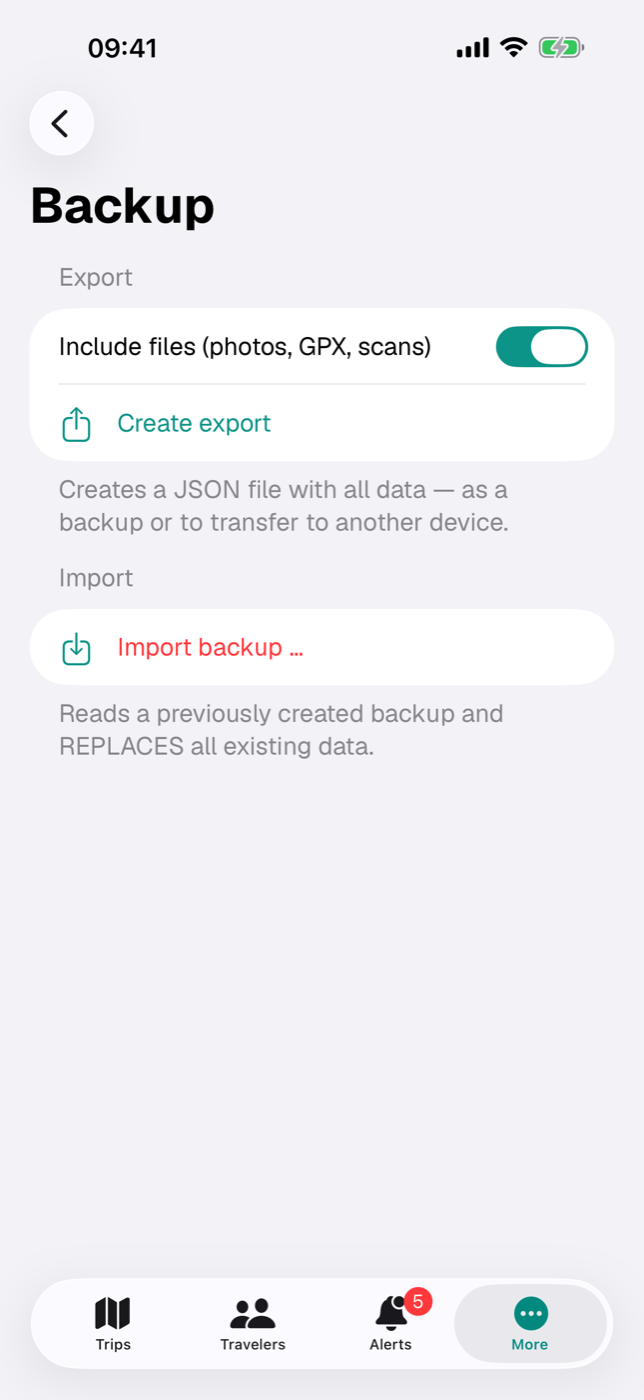
Everything you record in Etappe lives on your device. Backup turns it into a single file that you keep yourself — on your Mac, in the Files app, on a hard drive. It is also the way to move your data to another device if you don’t use iCloud.
You’ll find the section under More → Backup; on the iPad it sits in the sidebar under the same name.
35.1 Why a backup of your own makes sense#
iCloud sync is not a backup: it keeps your devices at the same state — including when you delete. What you remove on one device disappears on the others too (iCloud sync). An export, by contrast, freezes a state and stays untouched from then on.
Good moments for an export:
- before cleaning up under “Storage & files” (Storage and files)
- before loading someone else’s or an older backup
- before switching devices
- after every completed trip, once journal and photos are complete
35.2 Exporting a backup#
- Open More → Backup.
- Use the Include files (photos, GPX, scans) switch to decide whether the attachments go into the file. It is on by default.
- Tap Create export. While it runs, the button reads “Exporting …”; with many photos this takes a moment.
- Below it, a share row appears with the file name and size, such as Share “etappe-export-2026-08-10_14-30.json” (86.4 MB).
- Tap it and put the file somewhere — in Files, via AirDrop, by mail, or in a cloud service of your choice.
The last step is the one that counts: at first, the file exists only in a temporary folder. Only once you’ve stored it somewhere via the share sheet do you actually have a backup. The file name includes date and time, so several backups don’t overwrite each other.
With the switch off, the file becomes many times smaller: only text, numbers and links go in. The document entries are kept with name, type and size, but their content is missing — after such an import, the preview stays empty.
You can export at any time, even after the trial has expired. Importing a backup, on the other hand, is one of the writing functions and requires the full version or a running trial (Trial and full version).
35.3 Restoring a backup — and what happens when you do#
The import replaces the entire data set. It doesn’t merge anything: everything is deleted first, and afterwards the app contains only what is in the file. So two backups cannot be combined.
- In the Import section, tap Import backup ….
- Select the file. Only JSON files are offered; it may be no larger than 500 MB.
- Etappe asks Replace all data? and points out that the existing data will be deleted. Import carries on, Cancel stops without any effect.
- After loading, the Imported section appears with one line per area — trips, countries, people, documents / photos and so on — plus the total. So you can see right away whether the file was complete.
Deleting and inserting run as a single operation. If the import breaks off midway, the old data set is restored; you won’t be left with an empty app. Still: create an export first.
If the file doesn’t fit, Etappe says so in plain words instead of loading something halfway:
| Message | Cause |
|---|---|
| The file is not a valid Etappe export. | Any JSON file that isn’t an Etappe backup |
| Export version … is not supported by this app version. | Backup from a newer format version |
| The file could not be read: … | Damaged or incomplete file |
| “…” is … MB — the maximum allowed is 500 MB. | File over the limit |
If iCloud sync is turned on, an import also affects your other devices: the sync carries over both the deletion and the new data. So don’t run an import “just quickly” on a second device.
35.4 What the backup contains and what it doesn’t#
The file covers your entire data set, not just the trips:
| Area | Contents |
|---|---|
| Records | Continents, countries, places, people, pets, vehicles |
| Trips | Trips, participants, accommodations including campground details, journeys, activities, outdoor activities, pet planning |
| Planning | Sketch blocks, research items, to-dos, entry checkpoints, packing list and packing list templates, budget items, reminders |
| On the road | Journal entries, route recordings, checked-off items in the “Today” view |
| Health & documents | ID documents, vaccinations, vet appointments, medications, vehicle documents, service entries |
| Files | Photos, scans, GPX tracks, cover and profile pictures, country banners — provided the switch was on |
| Map | The countries from “Where I’ve been”, including the manually marked ones |
Not in the file:
- your Settings (display, name format, maps app, home, base currency) — they are quickly set again, and home and base currency are synced between your devices by iCloud anyway (All settings); the file only notes the base currency in its header for information, the import doesn’t change it
- the app lock code; it lives in the device’s keychain (App lock)
- local caches, which refill themselves as needed
- the purchase status of the full version; it is tied to your Apple ID, not to the data
35.5 Moving to a new device#
If you use iCloud sync, the move is already done: sign in on the new device with the same Apple ID, install Etappe and wait for the first sync (iCloud sync).
Without iCloud, the route goes through the file:
- On the old device, create an export with files.
- Store it via the share sheet where the new device can reach it — AirDrop, Files, an email to yourself.
- Install Etappe on the new device and finish the Getting started assistant with Close, without creating countries or travelers — the import replaces everything anyway.
- Open More → Backup → Import backup …, select the file and confirm with Import.
- Check the Imported list and spot-check a trip with photos.
Only then should you reset the old device — and keep the backup file for a while longer.
Linked from
- 2. Installation and first launch
- 5. Trial and full version
- 7. People
- 10. Packing list templates
- 11. Home
- 12. Creating a trip
- 17. Activities
- 20. Packing list
- 21. To-dos
- 23. Documents and receipts
- 24. Reminders
- 25. Today
- 31. Overview
- 33. Where I’ve been
- 34. Exports and printouts
- 36. Storage and files
- 37. iCloud sync
- 38. App lock
- 39. Your data
- 40. All settings
- 42. FAQ and troubleshooting
- 44. What’s next
- 45. Legal and contact